Friday, January 20, 2012

Bank Foreclosure Fraud - Exhibit XIII - Fraud Exposed By Understanding How ACH Transactions Really Work

This Exhibit was part of the 31-Count indictment that Spencer C. Young filed with law enforcement against Paragon Commercial Bank and Poyner & Spruill and concurrently shared with North Carolina Leadership as well as appropriate Federal authorities.  This exposes the basis upon which Paragon commenced its dastardly actions in carrying out the last phase in the Worst Bank Foreclosure Fraud in US History.


The Punch Line
Paragon abruptly rejected deposits to Mr. Young's Corporate bank accounts directly from his tenants  who had had long been remitting their monthly rent in this manner, in order to give the false impression that there were insufficient funds to cover the monthly debt service on his loans -- And despite this insidious act by Paragon, this was NEVER the case.

Paragon this unprecedented and patently absurd act on entirely convoluted logic.  They cited a credit risk associated with how the funds were being electronically transmitted, namely the Automated Clearing House, explained below, and a protection against fraud for CONSUMER under a Federal Regulation, which is diagrammed below, which allows CONSUMERs who pay in this manner up to 60 days to contest payments they were defrauded into making.  

The problem with this is that: (1) no tenant paid rent from a CONSUMER banking account; (2) no tenant had ever claimed to have been defrauded; and: (3) there was NO ASSOCIATED CREDIT RISK WHATSOEVER.  In other words, the rationale behind Paragon's insidious action was entirely concocted as part of their audacious bank foreclosure fraud.  For those so inclined, this is explained further below, including an explanation of the Automated Clearing House.


Rent Remittances

Mr. Young had long established arrangements with his commercial tenants to remit their monthly rent electronically via pre-established ACH arrangements with their respective banks such that they agreed to remit their monthly rent pursuant to pre-arranged debits from their commercial operating bank accounts for credit to Mr. Young’s designated operating account at Paragon Commercial Bank. 

What is important to keep in mind is that NONE of the tenants paid their rent from consumer bank accounts; rather rent was remitted from corporate business accounts. This is especially relevant because Paragon’s cited “exposure” from “numerous reversals” over the prior two months as the reason for abruptly canceling the ACH arrangements that were in place for many years (hence blocking the deposit of rental receipts). 

The Truth
Jim Hoose
The truth is: (1) there were NO reversals associated with the subject property over the prior two months as contended by Jim Hoose of Paragon; (2) there is NO exposure whatsoever if the ACH is coming from a corporate account at the RECEIVING bank (i.e., the bank that receives the instructions to DEBIT their customer’s account) TO a corporate account at the ORIGINATING bank (i.e., the bank that originates the instructions) such that the designated account at the ORIGINATING bank is CREDITED for the transferred funds; (3) Paragon actually increased its credit exposure by blocking the deposit of rent remittances; and therefore (4) Paragon’s action was merely a smokescreen for their Machiavellian scheme to orchestrate an entirely FRAUDULENT default on commercial mortgage loans that had an exemplary credit payment history since their inception, dating back to 2004. 

The exposure cited by Paragon is highly remote in practice, and pertains only to ACH transactions between a consumer account and a corporate account – which was NOT the case. In other words, Paragon fabricated a reason citing events that did not occur, predicated on a rationale that was entirely spurious, manifesting an increased exposure to the bank. And Mr. Young’s extensive banking background enabled exposing this obvious FRAUD.


Automated Clearing House
From Wikipedia, the free encyclopedia
Automated Clearing House (ACH) is an electronic network for financial transactions in the United States. ACH processes large volumes of credit and debit transactions in batches. ACH credit transfers include direct deposit payroll and vendor payments. ACH direct debit transfers include consumer payments on insurance premiums, mortgage loans, and other kinds of bills. Debit transfers also include new applications such as the Point-of-Purchase (POP) check conversion pilot program sponsored by NACHA-The Electronic Payments Association. Both the government and the commercial sectors use ACH payments. Businesses are also increasingly using ACH to collect from customers online, rather than accepting credit or debit cards.
Rules and regulations governing the ACH network are established by NACHA (formerly the National Automated Clearing House Association) and the Federal Reserve (Fed). In 2002, this network processed an estimated 8.05 billion ACH transactions with a total value of $21.7 trillion.[1] (Credit card payments are handled by separate networks.)
The Federal Reserve Banks are collectively the nation's largest automated clearinghouse operator and in 2005 processed 60% of commercial interbank ACH transactions. The Electronic Payments Network (EPN), the only private sector ACH Operator in the U.S., processed the remaining 40%. FedACH is the Federal Reserve's centralized application software used to process ACH transactions. EPN and the Reserve Banks rely on each other for the processing of some transactions when either party to the transaction is not their customer. These inter-operator transactions are settled by the Reserve Banks.

Uses of the ACH payment system
§  Debit card transactions
§  Direct deposit of payroll, Social Security and other government payments, and tax refunds
§  Direct debit payment of consumer bills such as mortgages, loans, utilities, insurance premiums, rents, and any other regular payment
§  Business-to-business payments
§  E-commerce payments
§  Federal, state, and local tax payments
§  Bank Treasury management departments sell this service to business and government customers

ACH process
An ACH transaction starts with a Receiver authorizing an Originator to issue ACH debit or credit to an account. A Receiver is the account holder that grants the authorization. An Originator can be a person or a company (such as the gas company, a local cable company, or one's employer).
In accordance with the rules and regulations of ACH, no financial institution may issue an ACH transaction (whether it be debit or credit) towards an account without prior authorization from the Receiver. Depending on the ACH transaction, the Originator must receive written (SEC Codes: ARC, POP, PPD), verbal (TEL), or electronic (WEB) authorization from the Receiver. Written authorization constitutes a signed form giving consent on the amount, date, or even frequency of the transaction. Verbal authorization needs to be either audio recorded or the Originator must send a receipt of the transaction details before or on the transaction date. An electronic authorization must include a customer reading the terms of the agreement and typing or selecting some form of an "I agree" statement.
Once authorization is acquired, the Originator then creates an ACH entry to be given to an Originating Depository Financial Institution (ODFI), which can be any financial institution that does ACH origination. This ACH entry is then sent to an ACH Operator that passes it on to the Receiving Depository Financial Institution (RDFI), where the Receiver's account is issued either a debit or credit.
The RDFI may, however, reject the ACH transaction and return it to the ODFI if, for example, the account had insufficient funds or the account holder indicated that the transaction was unauthorized. An RDFI has a prescribed amount of time in which to perform returns, ranging from 2 to 60 days from the receipt of the ACH transaction. However, the majority of returned transactions are completed within 24 hours from midnight of the day the RDFI receives the transaction.
An ODFI receiving a returned ACH entry may re-present the ACH entry two more times for settlement. Again, the RDFI may reject the transaction. After which, the ODFI may no longer represent the transaction via ACH.

Common issues
ACH payments have been around for some time now, but people are just getting used to them, especially with the ARC, POP, and RCK SEC Codes, where the original instrument was a physical check. One problem occurs when the account holder issues a stop payment on a physical check not knowing that the check was presented as an ACH entry.
Time frame differences can cause loss towards an RDFI when returned ACH entries are subject to the Electronic Funds Transfer Act (Regulation E). An example is for the ARC and POP SEC Codes, where an RDFI has only 60 days from the date of settlement to return an unauthorized debit, and the consumer has 60 days upon notification to dispute a transaction in his statement under Regulation E. The consumer can receive notification via a statement 30 days after settlement. With these time frames, it is possible that the 60-day period allowed for ACH return would expire even before the consumer's 60-day protection (under Regulation E) would expire, leaving the RDFI open to loss.
Another problem deals with compliance where the merchant presented with a check issues an ACH entry with SEC Codes ARC or POP. However, the merchant then fails to comply with the handling of the physical check and presents the physical check for payment as well. This causes a double-debit against a consumer account.

Bank Foreclosure Fraud - Exhibit VIII - Credibility Behind The Charges

Against . . .


That which follows evidences Spencer C. Young’s extensive expertise in banking and commercial mortgages, thereby underscoring the credibility behind the damning allegations against Paragon Commercial Bank and their attorneys Poyner & Spruill, resulting in a 31-count indictment, reflecting the manifestation of twenty separate elements of fraud in what was . . .


These include some Commercial Mortgage Backed Securities ("CMBS") trade articles, brochures associated with some of Mr. Young's professional speaking engagements, as well as professional evaluations received during his tenure as a commercial real estate investment banker at the “Houses of Morgan” – to wit, JPMorgan and Morgan Stanley, where he headed up their respective CBMS finance & securitization businesses (a/k/a CMBS conduits), and completed . . .

. . . $ 32 Billion in Transactions &
The #1 Ranking in CMBS Issuance

[ Note:  Reflected Above Is A Typical Morgan Stanley Trade Publication Advertisement  ]

The supporting documents included in this Exhibit are segregated into five sections, the context of which are summarized below, and can be accessed via hyper-links denoted in the "Section" column.


Pages

Section

Context

1 - 6
Evaluations from various colleagues at JPMorgan and Morgan Stanley over the years
Comments include:
·      “he's particularly good [at what he does] because of his knowledge of the commercial mortgage loan product and experience with financial institutions”
·      very effective at using his vast product knowledge to win business”
·      “has excellent [commercial mortgage] product/business knowledge and stays on the cutting edge of the market”
·      “has a solid background in financial institutions”
·      “has had a major impact on the organization”
·      “[clients have] the highest level of confidence and trust in [him]”
·      “is in a class of his own [and] has the respect and confidence of both clients and peers”
·      “clients think very highly of his opinion and ideas”
·      “is perceived highly for his knowledge and integrity
·      “in every case he is shown strong judgment
·       “clients find him credible and reliable; he enjoys strong relationships with a number of financial institutions”


7 - 19
Trade Articles on Commercial Mortgage Lending & Securitization
Various articles in the leading trade publications report on such items as: (1) JPMorgan heading the field shortly after Spencer C. Young founded the CMBS business there; (2) Mr. Young’s formation of the most “diverse and high-powered group of [financial institutions]”; (3) Mr. Young participation and viewpoints on a panel of experts discussing the fusion of Real Estate with Capital Markets at a Columbia-sponsored roundtable discussion; and (4) a front page article on Mr. Young’s plans for a fully-integrated real estate finance, securitization and investment program.

20 - 23
Listings of Chief Executives of the top CMBS Conduit Businesses
Various annual listings of the leading Wall St. Commercial Mortgage Lending & Securitization programs, along with their Chief Executives running those businesses, where Mr. Young is shown in that position for both JPMorgan and later Morgan Stanley.

24 - 30
Speaking Engagements Brochure Excepts and Topical Descriptions
Conference details of various buy-side and sell-side topics in Commercial Mortgage Lending & Securitization in which Mr. Young was featured as an expert in the field.

31 - 45
Notable Achievements in Commercial Real Estate Investment Banking
Includes: (1) Announcement of achieving #1 status as an underwriter of CMBS (Commercial Mortgage Backed Securities) while Mr. Young was running Morgan Stanley’s CMBS Conduit business; (2) details of the IQ® (“Institutional Quality”) brand of CMBS, which Mr. Young developed and trademarked, which was intrinsically worth in excess of $250 million; and (3) a humorous award presented to Mr. Young at one of the annual Mortgage Bankers Association conferences for developing a highly secretive “black box” underwriting and pricing model.

Thursday, January 19, 2012

Bank Foreclosure Fraud - Exhibit VII - Value of Properties Stolen by Banks


This addresses the market values of the properties STOLEN by: 
  • Wachovia Bank - This bank faced complete collapse after it was declared insolvent by bank regulators.  Wells Fargo, which initially received $25 billion in taxpayer bailout monies, and countless billions more in "printed taxpayer money" from the Federal Reserve, stepped in to subsume much of its banking operations after laying off thousands. After being granted this "lifeline", Wachovia then proceeded to STEAL The Courtyard of Chapel Hill via UNCONTESTED bank foreclosure fraud, because, together with their attorneys (Nelson Mullins) this bank, among other things, UNLAWFULLY prevented Spencer C. Young from hiring legal counsel.  When this fraud was brought to the attention of Wells Fargo executive management and their Board of Directors, they did NOTHING, and therefore tacitly endorsed this ILLEGAL activity.
  • Paragon Commercial Bank - This bank is comprised almost entirely of former Wachovia Bank executives and stole The Pit Stop of Durham and Mr. Young's residence in Chapel Hill via blatant and audacious bank foreclosure fraud, and was assisted by the law firm of Poyner & Spruill.  
Keep in mind, the highly coordinated bank foreclosure fraud was carried out by Wachovia and Paragon at the behest of Morgan Stanley (and their attorneys, Kirkland & Ellis) as a dastardly form of cover-up, so as  to deprive Mr. Young of resources and undermine his professional and personal credibility, so he could not viably pursue his now massive claims in the MorganStanleyGate scandal.

The below valuations reflect the redevelopment values based on then recently executed leases at the first two listed properties, along with relevant information supporting these valuations.


Property Name
Redevelopment Market Value

Basis for Valuation

The Pit Stop of Durham


 $7,745,000
Proforma / Actual Rent Roll as of January 2, 2008 based on most recently executed leases

The Courtyard of Chapel Hill

$11,760,000
Proforma / Actual Rent Roll as of January 2, 2008 based on most recently executed leases

Meadowmont Village Condo of Chapel Hill


    $525,000
Recent sales comps of similar units in Meadowmont Village and Orange County Appraised Real Estate Values as of Jan. 2008
Total
$20,030,000

Note:  The valuation of The Courtyard of Chapel Hill includes the Graham St. valet parking lots, which was financed by Paragon Commercial Bank.

Click here to access a more legible pdf version of this valuation analysis.

Click here to access a more legible pdf version of this valuation analysis.

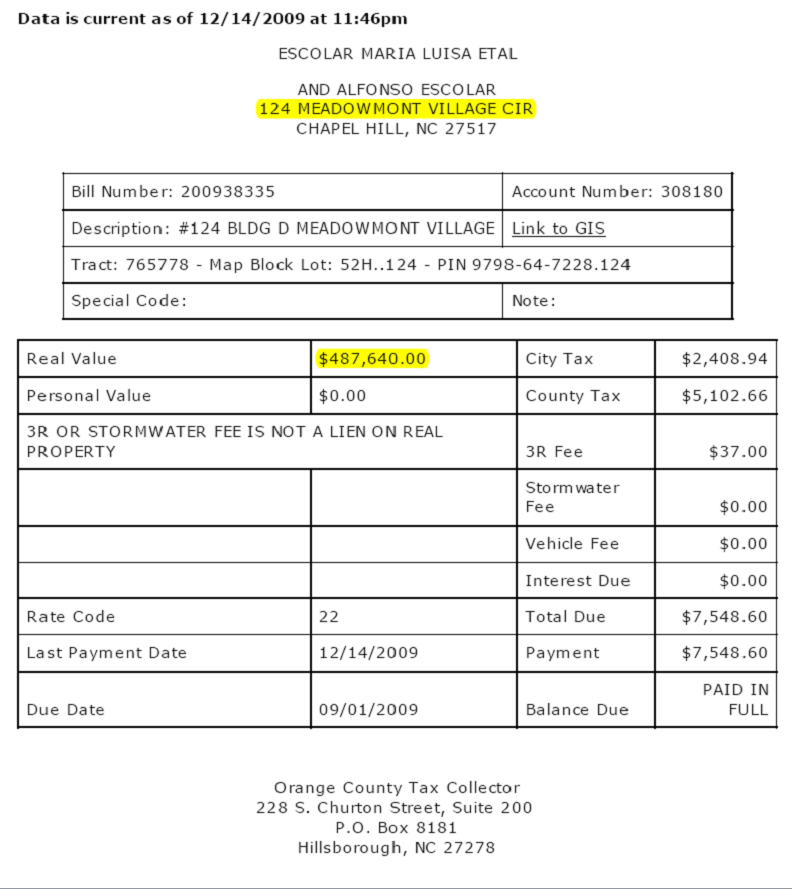
Below is the valuation per Jan 2008 Orange County appraisal of the Meadowmont Village condominium directly below Mr. Young’s unit #134. It has the same layout, except the two units have the following differences: (1) #134 has superior views, for instance #124 has southern views obstructed by rooftop HVAC units; (2) #134 has 10 foot ceilings while #124 has 8 foot ceilings; (3) #134 has an enclosed terrace, but #124 does not. Other 3rd floor condos less desirably located in Meadowmont Village have sold in excess of $500,000 – ergo the FMV of $525,000 for Mr. Young’s Unit is reasonable.  (Note:  This property was later fraudulently conveyed to James A. & Katherine K. Pope at a below-market "under-the-table" price of $422,000).

Click here to access a more legible pdf version of this valuation analysis.

Importantly, Congress did NOT bail out Banks so they could defraud and persecute the taxpayers who bailed them out. Moreover, the corruption observed in this matter alone, suggests a threat to the integrity of the U.S. Justice System may exist.

Bank Foreclosure Fraud - Exhibit VI - A Simple Case of GOOD vs. EVIL

Note:  Keep in mind, the narrative below was written before the violent fraudulent eviction of Feb. 2, 2010.

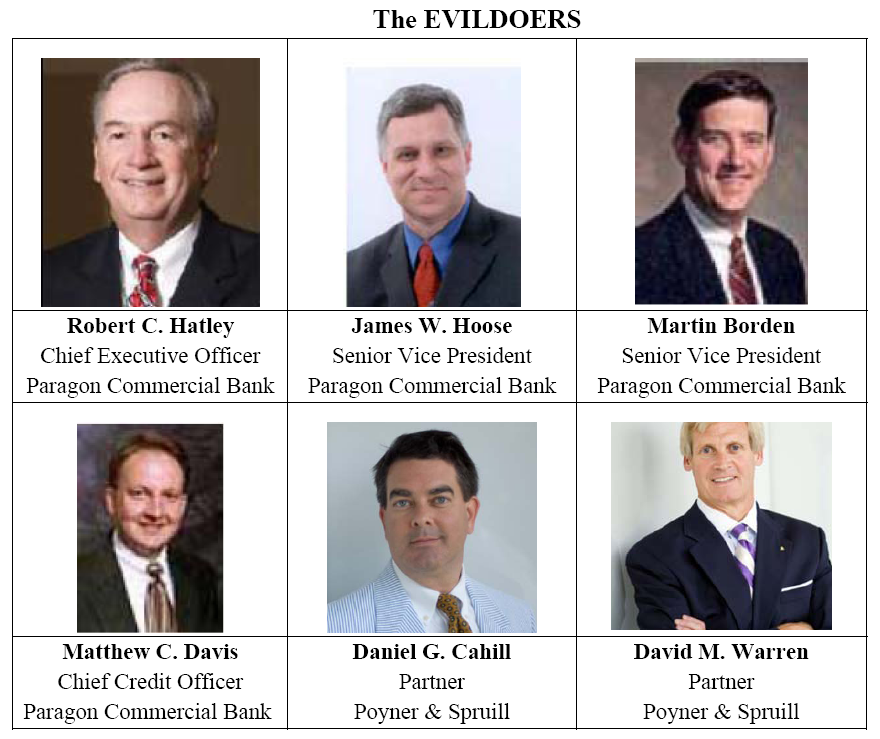
Reflected below are the “Mug Shots” of those responsible for committing the last, and most reprehensible phase of the Worst Bank Foreclosure Fraud in U.S. History, encompassing a range of CRIMINAL acts against Spencer C. Young, his family and friends, his affiliated companies, and the communities in which he and his family reside, and in which he has invested. The person leading this detestable assemblage of evildoers is Bob Hatley, CEO of Paragon Commercial Bank.


This is an especially heartless group, devoid of any sense of humanity – in short, they are MONSTERS. They have directly engaged in, or otherwise been complicit to CRIMINAL activities, including: Fraud, Racketeering, Extortion, Sabotage, Corruption and Assassination, both attempted (against Mr. Young) and realized (against his wife of 24 years).  Their malicious and aggressive actions are intended to bring unimaginable pain and suffering to Mr. Young and those in his extended family who have long depended on Mr. Young for financial support – and because their actions were knowingly undertaken to cause the death of certain family members – they are MONSTERS and they are as EVIL as EVIL can be.

Reflected below are photomontages of just some of the victims, along with brief contextual background summaries on each. They are all kind, innocent and GOOD people -- ergo, this matter couldn’t be a more clear-cut instance of . . .

GOOD versus EVIL

Jackson Young – The first of the GOOD people being persecuted in this matter is Mr. Young’s youngest son, Jackson Young (born in April 2008), whom Mr. Young often cares for, when Jackson’s mother (Mr. Young’s fiancée) is away on business (she is a flight attendant). Through FRAUD, the Evildoers are aggressively trying to evict and render homeless this GOOD little boy – moreover, they have plans in place to orphan “Jack”, so that Mr. Young will be forever silenced, thereby covering up widespread criminal activities that Mr. Young is blowing the whistle on.


Relationship with Sons – In addition to little “Jack”, Mr. Young has three older sons, Michael Young (born in 1986), and fraternal twins Kevin & Ryan Young (born in 1989). Throughout their childhood, Mr. Young was actively involved in their lives – he coached virtually every one of their sport teams, and arranged his vacations so he could take them to summer lacrosse camps, and serve as a counselor. So it should come as no surprise that they all played lacrosse for two of the top colleges, one played in three NCAA Final Four Championships and one became an All-American.

Mr. Young deeply loves each of his sons – they are GOOD kids. And it pains him terribly that his relationship with his older sons has become effectively estranged. This is because they have heretofore been unable to comprehend how their father, who regularly had a seven-figure annual income while they were growing up, could so suddenly be unable to provide for them financially.

By FRAUDULENTLY depriving Mr. Young’s of income from his commercial properties, the Evildoers committed grand larceny theft, thereby causing unimaginable pain and suffering and extensive damages to Mr. Young and his extended family whom have long relied on him for financial support.


Maria Young – Maria was married to Mr. Young for 24 years – she too is a GOOD person. Without question, their marriage would have endured for the remainder of their lives had it not been subjected to the unimaginable and unrelenting stress of the FRESCA[1] crimes, the “coup de grace” phase of which is being executed by the Evildoers.

The objectives of the Evildoers' CRIMINAL ACTIVITIES were to: (1) deny Maria necessary chemotherapy and radiation treatments for her advanced pancreatic cancer; (2) render Maria and her three sons homeless; and (3) make it appear that Mr. Young abandoned them. In effect, this is a Machiavellian recipe for MURDER and the vicious decimation of a once close and loving family.


[1]Acronym for Fraud, Racketeering, Extortion, Sabotage, Corruption, and other unlawful Abuse-of-authority

Leah Krier – Leah is Mr. Young’s fiancée – she is a GOOD person from a large family in Kansas. Her marriage to Mr. Young was delayed by the fraud, which sullied his sterling personal credit rating – and their marriage will continue in abeyance until this is cleared up. Leah gave birth to Mr. Young’s fourth son, Jackson in April 2008, and balances her career as a US Air Flight Attendant and caring for “Jack”.

Through their CRIMINAL FRAUD, the Evildoers are aggressively trying to render Leah and llittle Jackson, homeless.


Michael Young – Michael graduated with honors from Duke University in May 2008, and played for the Duke Men’s Lacrosse Team – He’s a GOOD young man. He was consistently selected to the ACC Academic Honor Roll and was a consummate unselfish player on a team that went to the NCAA Final Four Championships in 3 of the 4 years he played. He now works for Lazard, one of the world’s top financial advisory and asset management firms. It is Michael’s income that thwarted the Evildoers’ attempt to render Michael’s mother, who is stricken with cancer, homeless.


Ryan Young – Ryan is a natural leader and a standout in lacrosse, evidenced by his: (1) selection as a 1st Team High School All-American; (2) ranking as the 7th best player in the nation entering college; (3) gold medal for Team Long Island in Empire Games; (4) gold medal for Team USA in the World Games; (5) running University of Maryland’s offense since day one as a freshman, an remarkable feat; (6) selection as an NCAA All-American as a sophomore; and (7) appearance on the covers of Lacrosse Magazine and the Inside Lacrosse 2010 Yearbook. He is a GOOD young man.

Through their CRIMINAL ACTS, the Evildoers want Ryan to drop out of college, and homeless.

Note: Ryan wore #48 as a freshman and #27 as a sophomore for Maryland, # 8 in the Under Armor All-Star Game, #44 for Team USA in the World Games and #7 for an article on the Top 10 players.

Kevin Young – Much like his brothers, Kevin achieved significant success in high school. He was a honors student at Chaminade H.S., as he led his varsity lacrosse squad to a two year record of 35 wins and only 6 losses, achieving the league title each year, and receiving All-League and “Midfielder of the Year” honors. He is an exceptionally unselfish player who also led his JV and Freshman lacrosse teams to league titles and in the two years that he played football (he was captain) his squad was league champion each year. Kevin is a “winner” and quietly leads by example.

As a member of the Duke Men’s Lacrosse Team, similar success during his first two years has been hampered by a nagging ankle injury. Once healthy though, Kevin is expected to realize much the same success in college as his brothers – in fact, he is stronger and faster than both Michael and Ryan – pound-for-pound, he may be the strongest player in college lacrosse, and he possesses world-class speed.

Through their CRIMINAL FRAUD, the Evildoers aggressively sought to force Kevin to drop out of Duke University and render him homeless.


Edna May Young – Mr. Young’s mother has depended on him for financial support since her husband (Mr. Young’s father) passed away in 1986. Once a vibrant and energetic fashion model, Edna May is now elderly (born in 1926), and has a heart condition. She is absolutely devastated and distraught that Mr. Young is now unable to provide her the financial support she has depended upon for over 30 years, and which she now so desperately needs. She is a GOOD and kind woman.

The Evildoers were fully aware of this situation, as this information was shared with them on MANY occasions. Therefore in undertaking their CRIMINAL FRAUD, it was their deliberate and decidedly evil intent to create a level of distress that would end up killing Mr. Young’s mother – this is yet another of the Evildoer’s Machiavellian plans to carry out a surreptitious premeditated MURDER. Thankfully, Mr. Young’s brother-in-law is a physician, and together with Mr. Young’s sister, Denise, have thwarted the Evildoers’ murderous plans for Mr. Young’s mother.

Note: the above pictures of Mr. Young’s mother are circa 1955 through 2005.

Spencer Young – Mr. Young is a GOOD man. He was born in 1956, and the below pictures are circa June 2007 through October 2009. He maintains his “temple” of 6’ 2” & 195 lbs. from when he played football for Cornell University through rigorous exercise and practice of martial arts (Tae Kwon Do, Shotokan & Kyushojutsu) over the past 30 years. This has provided him with a high energy level, an introspective sense of confidence and unwavering focus that many find astonishing – but these are absolute imperatives in order to prevail in his quest for truth and justice. And toward this end, he is focused on exposing and extricating the Evildoers from their respective positions of authority, so they can no longer be in a position to inflict malicious harm to others.

Mr. Young will NEVER give up on this pursuit – for its importance cannot be overstated.

Wednesday, January 18, 2012

Bank Foreclosure Fraud - Exhibit IV - Evidence of Perjury in Paragon's Response to Regulators


On May 26, 2009, complaints over the criminal fraud committed by Paragon Commercial Bank were filed with the Federal Deposit Insurance Corporation and the Office of the Comptroller of Currency, who in turn forwarded the complaint to the North Carolina Banking Commission

Matt Davis
On Jun. 26, 2009, Matt Davis the Chief Credit Officer of Paragon Commercial Bank responded to the FDIC. For reasons that have yet to be explained, and viscerally appear suspicious, the FDIC withheld Paragon’s response before forwarding to the complainant (Spencer C. Young), who received it A MONTH LATER on Jul. 27, 2009. 

Mr. Davis’ filed response to the FDIC is so bombastically false it is an apostasy, and an instance of criminal perjury, as evidenced in the table below.


Paragon’s Perjury
The Truth
“Paragon Commercial Bank denies each and every claim made by Mr. Young in his complaint.”
As evidenced herein, all the stated claims (i.e., the 31 Counts and the 20 elements of bank foreclosure fraud) are true, accurate and most importantly, irrefutable.
“All four loans are currently in default and are the subject matter of collection litigation by Paragon.”
Paragon’s declarations of default on the four subject loans were instances of criminal FRAUD, the evidence of which are undeniable and irrefutable. The collection litigation is entirely bogus and a blatant example of a frivolous legal claim.
“Payments on these loans are past due from January and February 2009.”
False.  Dating back to December 2004, the monthly debt service for these loans have always been paid on or before their due dates, and typically more than two weeks prior to the last day of the grace period for such payments.  In blocking the receipt of tenant rent remittances for deposit, wiring out funds without authorization and failing to follow express instructions to apply available funds on deposit to service the loans, and then declaring bogus monetary defaults on all four loans, Paragon committed criminal fraud.
“Paragon has also filed a complaint against Mr. Young in NC State District Court for non-payment of these debts.”
The filing their complaint in NC District Court is a further manifestation of criminal fraud, as well as tortious interference in the engagement of legal counsel and denial of due process.
” A receiver has also been appointed by the District Court over Spencer C. Young Investments, Inc.’s assets.”
This is yet another manifestation of criminal fraud, and tortious interference in the engagement of legal counsel and denial of due process in that they: (1) accelerated the hearing to appoint a Receiver; (2) threatened any attorney who would represent Mr. Young’s interests; (3) never had to prove a monetary default; and (4) prevented Mr. Young from presenting irrefutable evidence that there was NO MONETARY DEFAULT, and that PARAGON and POYNER & SPRUILL engaged in CRIMINAL FRAUD, and other unlawful activities.
“Paragon denies it has reneged on any financing proposals to Mr. Young or his related entities.  Paragon last extended credit to Young in January 2008.”
As noted in the “Complainant’s Background and the section of the same name in his letter to the NC Leadership, and in Exhibit II, Mr. Young has a deep and distinguished background in finance and banking, with particular expertise in commercial mortgages.   Mr. Young has successfully owned and managed commercial income producing properties for over two decades.  Moreover, he has overseen or otherwise been involved in over $50 billion in commercial mortgage related transactions.  Accordingly, Mr. Young’s background as measured by business volume in commercial mortgages is multiples greater than the experience base of all Paragon bankers combined.  And their denial of having reneged on any financing proposals is patently absurd – for no bank would EVER complete the referenced January 2008 financing (a 12 month, 100% loan-to-cost financing, and knowingly waive the payment of past due property taxes) without carrying out Phase II, which encompassed refurbishing working capital, and financing the improvements, upon which future leasing hinged.  They also reneged on a critically important collateralized line of credit.
Subsequent to that time, Paragon became aware through public records of various credit issues related to Mr. Young, including notices of liens being placed on various properties he owned and foreclosure proceedings by other lenders.
It is because of such bombastically false statements as this, and the belief that this level of deceit is pervasive throughout Paragon Commercial Bank that Mr. Young now seeks the dissolution of Paragon Commercial Bank as a going concern for they are clearly dangerous to the general public. Paragon was apprised of ALL aspects of Mr. Young’s finances, and acknowledged their understanding and were comfortable with: (1) the personal credit events, which were those of his now ex-wife that were beyond his control at the time; and (2) Mr. Young’s solution to the UNLAWFUL parking lot blockade at The Courtyard of Chapel Hill

Tuesday, January 17, 2012

Bank Foreclosure Fraud - Complaint Filed With OCC Passed To NC Banking Commission And Then Ignored

Reflected below is the complaint filed with the Office of the Controller of the Currency ("OCC"), which has  regulatory oversight over national banks. Although Paragon Commercial Bank is not a national bank, their malicious acts were coordinated with Wachovia Bank (now part of Wells Fargo), and carried out at the behest of Morgan Stanley, both of which are national banks. 

Importantly, one of the primary mandates of the OCC is to regulate and supervise banks such that they operate in compliance with laws requiring fair treatment of their customers, which based on the 20 separate elements of foreclosure fraud and the filing of a 31-count indictment, Paragon did NOT do in any way, shape or form.

Notwithstanding, as reflected below, the OCC was provided particulars about what is arguably the worst bank foreclosure fraud in U.S. history on mortgage loans that were:
  • ALWAYS paid before the monthly due date
  • NEVER delinquent
  • NEVER in default, and in the case of Mr. Young's residence . . . 
  • PAID-IN-FULL !!
The OCC said it did not have jurisdiction on the matter, and handed to complaint over the the North Carolina Office of the Commissioner of Banking . . .

. . . Who Did NOTHING Whatsoever !!

This alone suggests a profound level of corruption exists, which MUST be addressed. 


Bank Foreclosure Fraud - Complaints Filed With the FDIC & It's Response Suggest PROFOUND Corruption

Reflected below are the complaints filed with the Federal Deposit Insurance Corporation, which has Federal regulatory oversight over Paragon Commercial Bank, whose mandate is to provide stability and public confidence over the U.S. banking system.  Notwithstanding, as reflected below, the FDIC was  provided particulars about what is arguably the worst bank foreclosure fraud in U.S. history on mortgage loans that were:
  • ALWAYS paid before the monthly due date
  • NEVER delinquent
  • NEVER in default, and in the case of Mr. Young's residence . . . 
  • PAID-IN-FULL !!
. . . The FDIC did NOTHING Whatsoever !!

This alone suggests a profound level of corruption exists and MUST be addressed. 


[Note:  the 4th page of form was blank and therefore omitted here.]